Gap Funding Explained: How to Make It Work for Your CRE Deals

You know that sinking feeling when you sprint to the airport gate only to find the plane door already closed?
In commercial real estate, missing a deal feels the same, except instead of a missed flight, it’s a missed property, and instead of hours lost, it’s millions in potential returns.
Often, the problem isn’t the property itself, but the timing. Lenders move slowly, closing costs pile up, and investors get stuck waiting for financing while competitors swoop in.
That gap between what you have and what you need is where deals die.
Gap funding exists to prevent that. It’s short-term, flexible capital that fills the financing void, helping borrowers act quickly while keeping their own money out of it.
In this article, we’ll make this popular funding option clear by talking about the following:
- What is gap funding?
- What is an example of gap funding in commercial real estate?
- 5 benefits of gap funding in commercial real estate
- Why gap funding matters in today’s market
Don’t let a gap in your funding blow a hole in your next deal. Contact Duckfund to find out how our fast, flexible financing can secure you a property in 48 hours.
What is gap funding?
Gap funding is short-term capital designed to cover funding shortfalls, or the “gap”, in real estate projects. Many people confuse it with a bridge loan, but gap financing is usually smaller in size and more short-term.
Here’s how it works: a borrower secures primary financing from a traditional lender, but the loan doesn’t cover all the total project costs. That leaves a financing “gap”, which might include a down payment, closing costs, or unexpected expenses during rehabilitation or refinance.
Instead of letting the deal slip away, investors often turn to a gap funder.
What is a gap fund?
A gap fund is a pool of money that a specialized money lender prepares for temporary financing until long-term capital, permanent loans, or equity contributions come through.
Such a fund creates a win-win: the investor keeps the deal moving, while the lender gets to charge a higher interest rate than for most other loans.
What is an example of gap funding in commercial real estate?
Let’s make the concept of gap funding crystal clear with a real-world example for the US market.
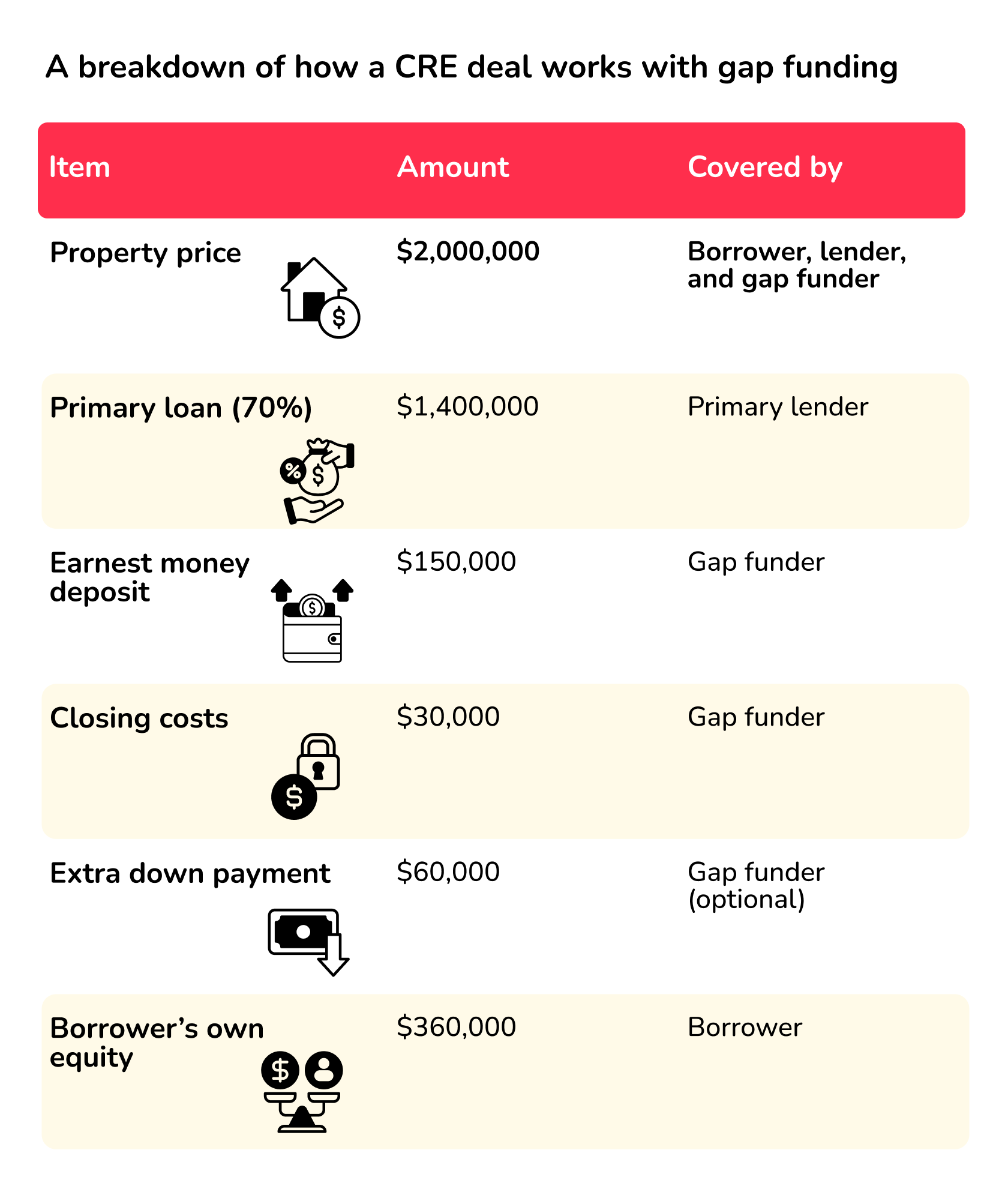
A developer is acquiring a commercial property at $2 million. The primary lender agrees to finance 70% ($1.4 million), leaving $600,000 in equity that the borrower must cover.
To lock the deal, the developer needs to put down an earnest money deposit (EMD) of $150,000 immediately, plus pay closing costs of around $30,000, and make a down payment portion not supported by the lender (let’s say $60,000).
The developer doesn’t want to tie up their own money or deplete cash reserves that are needed for another rehab opportunity underway.
So, a gap funder steps in with short-term gap funding:
- Covers the $150,000 earnest money deposit to secure the funding
- Takes on the $30,000 in closing costs up front.
- Possibly helps with the extra $60,000 down payment portion beyond what the primary lending allows.
Once the permanent loan (or bridge loan in this case) closes in, say, four to six weeks, the developer repays the gap loan with interest.
What are other examples of gap funding in CRE?
Gap funding isn’t just for earnest money deposits or down payments — it can help investors at multiple stages of a commercial real estate project, whether a multi-family development or office space.
Other examples of gap funding in CRE include:
- Renovation projects
When construction or renovation costs exceed the original budget, gap financing provides the extra capital to finish the project.
- Refinance situations
Investors use gap funding to bridge shortfalls until a refinancing deal is finalized.
- Early-stage development
Gap funding can also cover land costs, permits, or pre-construction expenses when initial capital falls short.
In each case, gap funding lets investors move forward without stalling their projects and missing out on future returns.
5 benefits of gap funding in commercial real estate
CRE investors deciding to opt for gap funding might hesitate due to the high interest rates that come with it, but its benefits will likely outweigh them. Here’s a summary of them.
1. It gives faster access to funding than other sources
Traditional lenders can take weeks (or even months) to approve a loan.
Gap funding is designed for speed, often providing capital in just a few days, and many lenders now use the latest technology to approve borrowers quicker than ever.
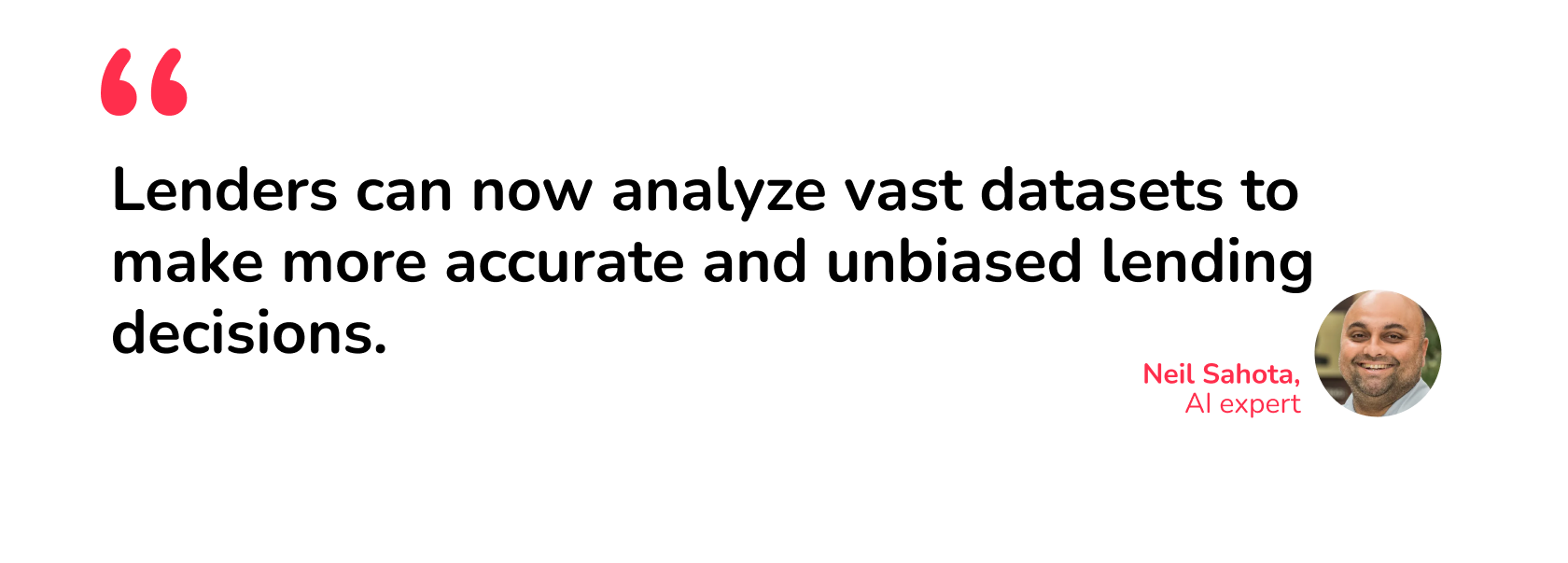
“AI has paved the way for a revolution,” says AI expert Neil Sahota, speaking to Forbes. “Lenders can now analyze vast datasets, including credit scores, income details, employment history, and even social media behavior, to make more accurate and unbiased lending decisions”.
For investors competing in fast-moving CRE markets, this swifter lending process can be the difference between closing a deal and losing it.
2. It gives investors stronger negotiating power
In a competitive bidding environment, sellers want certainty.
Real estate investors with a gap funder on hand can move quickly, place stronger offers, and negotiate from a position of confidence, knowing that they have a pool of capital to fall back on.
3. It’s more flexible than other lending options
Gap financing isn’t limited to acquisitions. It supports a wide range of needs: early-stage costs, refurbishing budgets, unexpected closing costs, or even refinance gaps.
That flexibility makes it a valuable tool across the entire CRE lifecycle and a key part of a smart investor’s arsenal of funding options.
4. It protects the investor’s cash flow and liquidity
High liquidity is the oil that keeps the chains of CRE deals moving.
Investors can avoid tying up their own money in deposits or construction overruns and use gap funds instead. They can also pursue multiple deals at once and avoid disruptions in cash flow.
5. It reduces investor vulnerability in a volatile market
Markets shift fast – interest rates rise, lenders tighten requirements, and projects hit roadblocks.
Gap funding helps investors keep their momentum going, protect their track record, and safeguard long-term sustainability.
Why gap funding matters in today’s market
The commercial real estate market has felt the squeeze in recent years. Tighter lending rules and ongoing economic uncertainty have made it harder than ever to secure traditional financing.
Yet investors are finding creative ways to get around these roadblocks. US commercial property transactions hit $100.6 billion in the first quarter of 2025, a 14% rise from the previous year, according to a recent MCSI report. The Lightbox CRE Activity Index also soared to 113.9 in June, its highest since October 2022.
How CRE activity is increasing in the United States
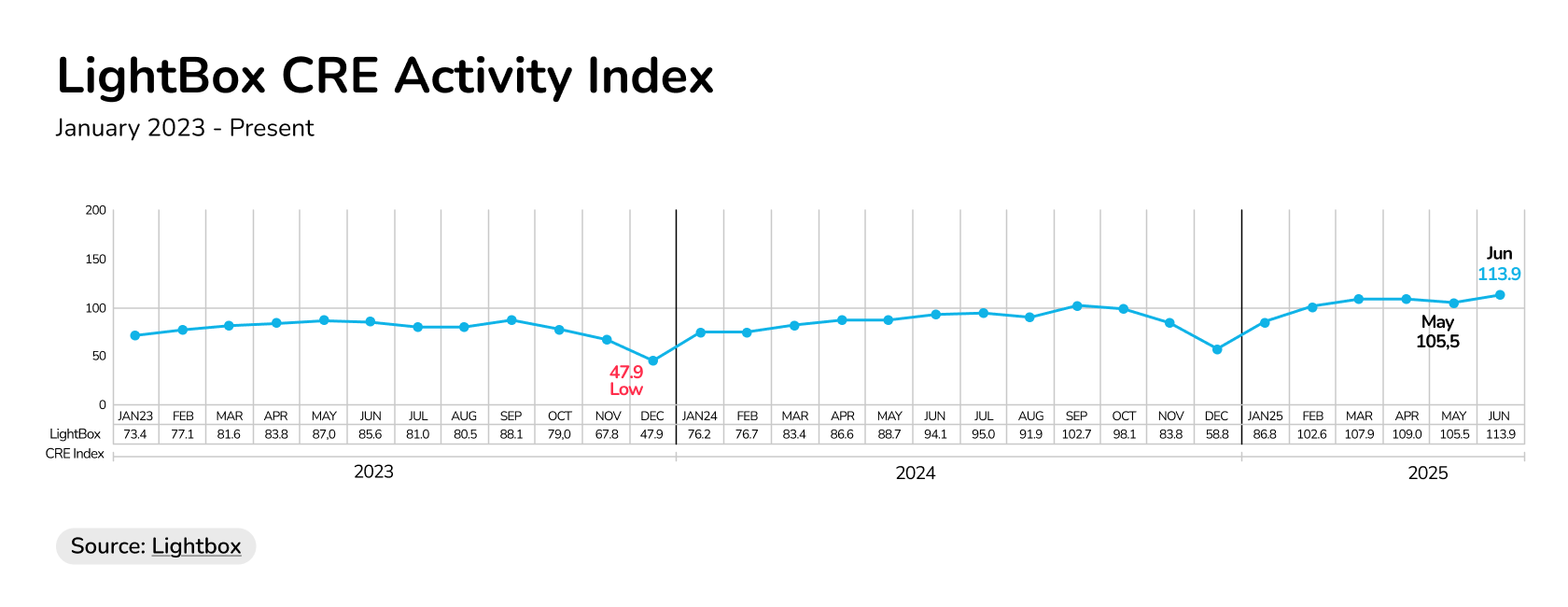
Source: Lightbox
The CRE pricing gap is narrowing, and gap funding is playing a key role. Fast and flexible, it’s helping investors move quickly in a busy market.
Final takeaway
So, what does gap funding mean for CRE investors? In simple terms, it’s a way to keep deals alive when traditional financing falls short.
At Duckfund, we specialize in helping commercial property investors secure funding for earnest money deposits — one of the most common gaps in CRE deals. Our fast, flexible approach ensures you don’t have to risk your own money or lose momentum in today’s competitive market.
As CRE momentum heats up, deals shouldn’t have to wait – and neither should your financing.
Ready to see how we can help you grow your portfolio? Sign up for Duckfund and unlock fast, flexible funding in minutes.
Real Estate
Financing

- Approval within 24 hours
- Fund multiple properties at once
- No full deposit upfront — soft deposit only
- Apply in under 2 minutes
Secure your next commercial property acquisition — zero upfront capital required.
Start with Duckfund’s EMD financing program.- No capital commitment
- Close faster
- Scale with confidence