How to Navigate the Industrial Real Estate Market in 2026 (Trends & Challenges Report)

After years of market correction, the industrial real estate market is entering 2026 with fresh momentum. While the commercial real estate market and economy at large still face headwinds – think of elevated interest rates, uncertainties around tariffs and monetary policy, and shifting occupier preferences – industrial properties are proving to be assets with resilient fundamentals.
But CRE investors have to tread carefully. Gone are the pre-pandemic days of explosive growth. Today's industrial property market rewards selectivity, punishes outdated inventory, and demands a deeper understanding of which trends matter and which markets offer genuine opportunity.
CRE investors navigating the industrial sector in 2026 face three critical challenges:
- Rising cap rates and tighter financing are compressing deal economics
- Growing divergence between Class A and obsolete assets is creating a bifurcated market
- Regional supply-demand imbalances mean that strong national fundamentals don't guarantee success
This industrial real estate market report examines where the sector stands heading into 2026, why industrial continues outperforming other property types, which trends savvy investors should capitalize on, which challenges they should watch out for, and three markets worth watching closely this year.
[Need flexible capital to move quickly on industrial opportunities? Sign up now for Duckfund's soft deposit financing and start bidding on multiple properties without tying up your liquidity.]
The state of the industrial real estate market in 2026
So what is going on with the commercial real estate market as we move into 2026? The answer depends on which commercial real estate sector you're looking at.
The office sector remains stuck in the downturn that started with the pandemic. National office vacancy rates averaged 18.4% at the end of last year, according to market intelligence platform Yardi Matrix — levels not seen in decades. Multifamily markets, meanwhile, are grappling with waning deliveries alongside sharply decelerating starts, a PwC 2026 outlook notes, while demand moderates amid slower job growth and reduced immigration.
Against this backdrop, industrial real estate stands apart from other assets.
Leasing momentum surged by 12% throughout 2025, according to an industry sector report by CRE firm CBRE. Leasing activity even accelerated in Q4, when net absorption accounted for 39% of the annual total. Yet strong absorption wasn’t enough to offset new construction completions, with vacancy rates reaching 6.7% in Q4.
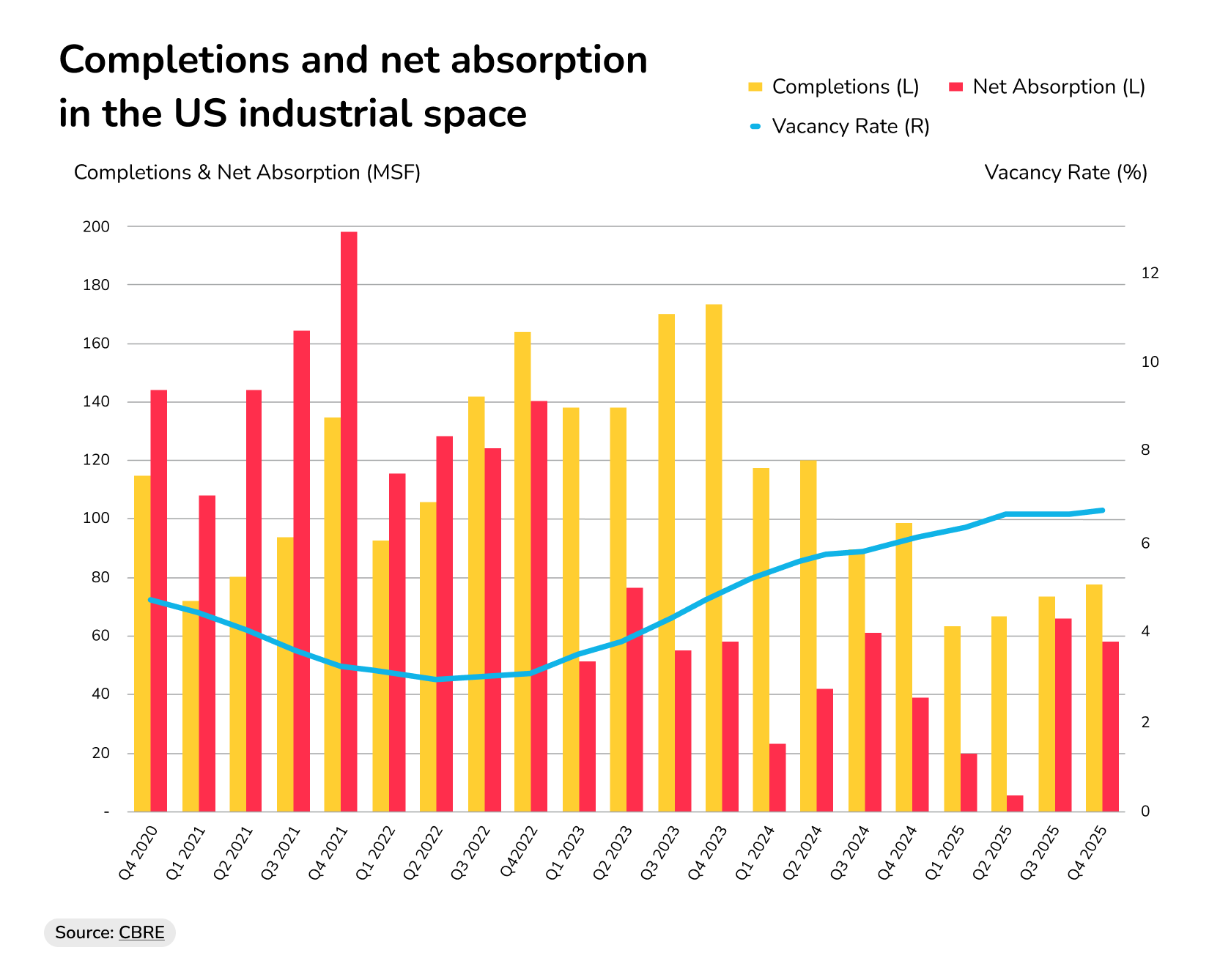
Source: CBRE
But more importantly, vacancy increases have decelerated sharply, analysts at CRE firm Cushman & Wakefield note. Year-over-year vacancy rose just 50 basis points in Q4 2025 — the smallest annual increase since late 2022. Roughly 53% of U.S. industrial markets saw vacancy rates remain flat or decline quarter-over-quarter in Q4.
This kind of occupancy indicates that the supply-demand equation is rebalancing. CBRE's Q4 2025 figures show that space under construction fell 12.7% year-over-year to 220.6 million square feet — the smallest construction pipeline since 2019. Industrial development activity is seeing a slowdown as speculative construction becomes uneconomical and lenders tighten financing requirements for new projects.
This supply pullback is creating favorable conditions heading into the first quarter and rest of 2026. Moody's projects that industrial will deliver approximately 3% annual rent growth in 2026, which is the highest across all commercial property types, and a stark contrast to the stagnation seen in office and the modest gains in retail.
Why is industrial real estate booming? 4 trends explained
Even as macroeconomic uncertainty continues to haunt commercial real estate, national industrial properties from New York to Texas continue to outperform other asset classes. So what’s driving this sustained tenant demand?
- Continued growth in e-commerce. Online shopping accounted for 16.4% of total U.S. retail sales in Q3 2025, according to the U.S. Census Bureau, up from 15.2% from last year. That translates into sustained hunger for warehouse space.
The global e-commerce warehousing market is projected to exceed $7 trillion by 2030, according to market analyst Research and Markets, with demand particularly acute for high-velocity fulfillment centers optimized for rapid order processing rather than long-term storage.
Forecasted global e-commerce warehouse market growth
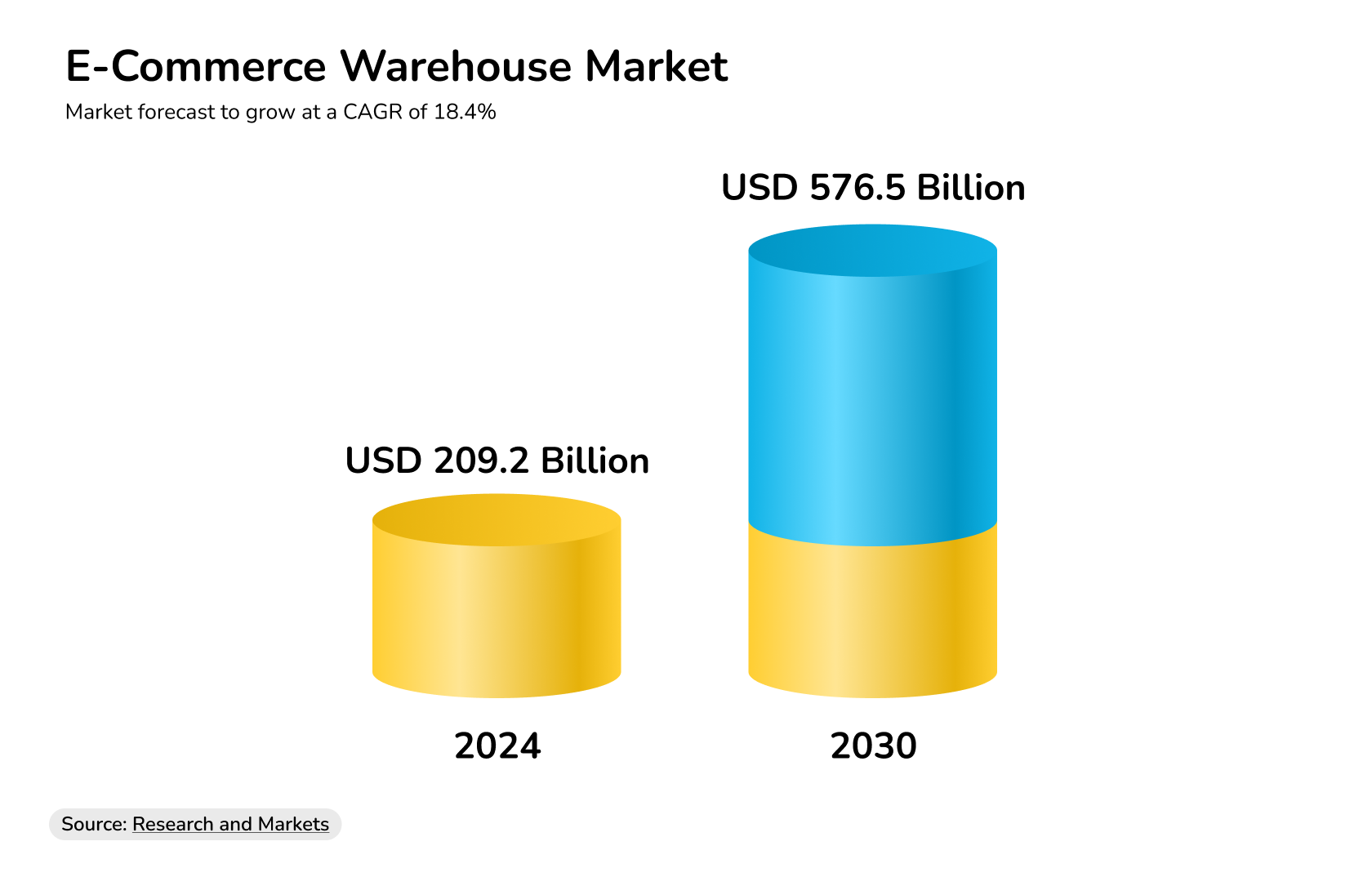
Source: Research and Markets
- Last-mile logistics demand shows growing demand. Tying into the boom of e-commerce, the last-mile delivery market is projected to grow from $185.76 billion in 2025 to $487.20 billion by 2035, according to market analyst Precedence Research, representing a 10.12% compound annual growth rate.
Projected global growth in last-mile logistics
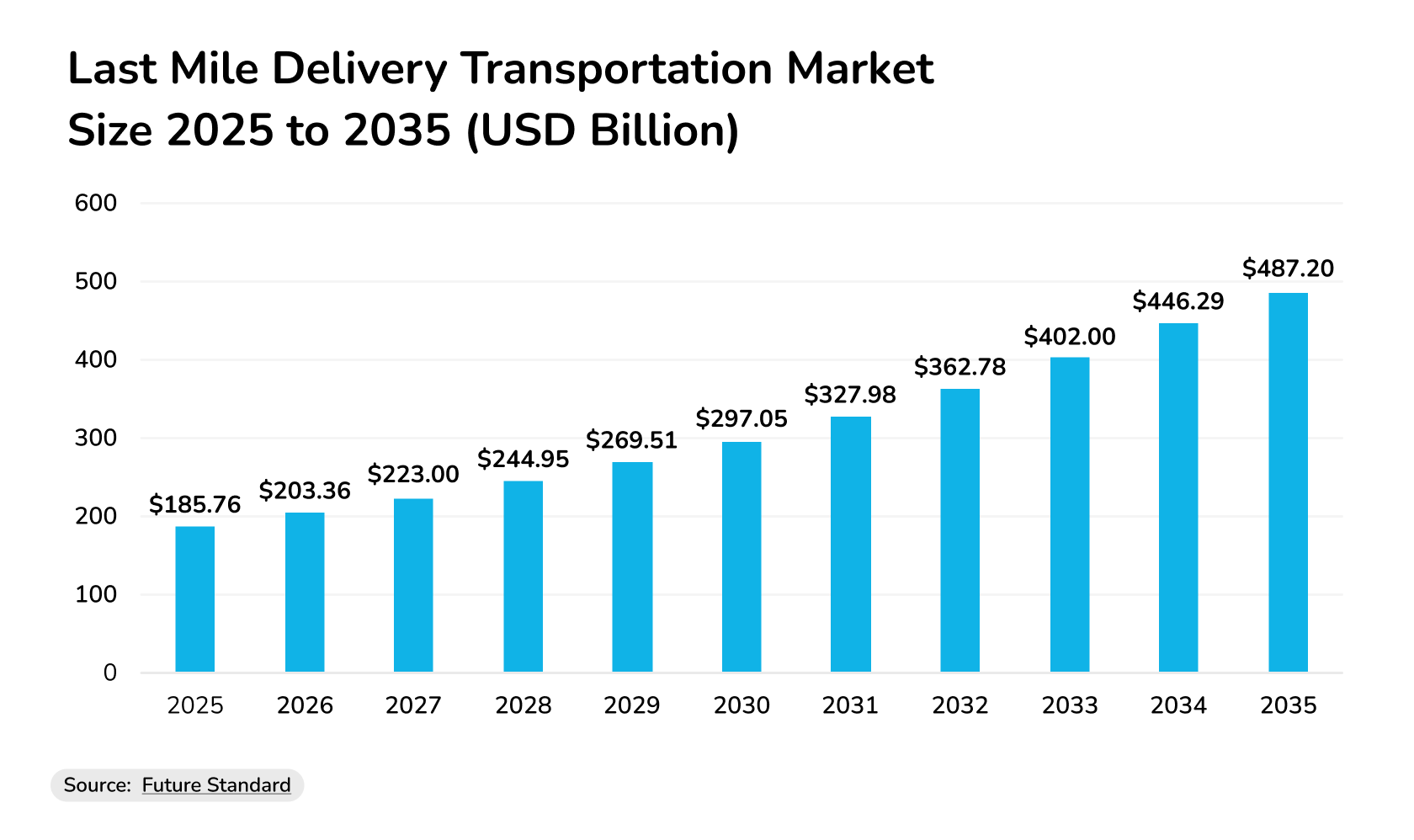
Source: Precedence Research
“Currently, aggressive drive for last-mile logistics spaces close to high-density urban centers is the biggest trend,” says Austin Rulfs, who is the founder of mortgage broker Zanda Wealth. “As consumers expect more rapid delivery times, businesses are scrambling for warehouse space, which reduces transit distance.”
But, Rulfs adds, “this demand comes up against a brick wall with the shortage of available commercial land and soaring construction costs.” Indeed, a basic industrial market research on urban-adjacent distribution centers and micro-fulfillment hubs shows premium rent pricing.

- Supply chain reconfiguration due to tariff disruptions and trade policies, as well as mounting geopolitical tensions. Reshoring and nearshoring trends are bringing manufacturing closer to end markets.
A 2025 manufacturing survey among 500 US manufacturers found that 45% of companies cite locating manufacturing near engineering teams as a top reshoring priority, while another 45% point to reduced freight and duty costs. Geopolitical risk avoidance ranked third at 38%. This industrial property market analysis reveals companies are prioritizing supply chain resilience over lowest-cost sourcing, creating sustained demand for domestic production facilities. - Government incentives that incentivize facility construction. Take the CHIPS Act, allocating a whopping $39 billion for domestic semiconductor manufacturing, with companies like Taiwan Semiconductor Manufacturing Company committing $65 billion in U.S. investments and Intel pledging $100 billion over five years.
Mega deals like these require supporting infrastructure, including warehouse, logistics facilities, and auxiliary services.
These are all fundamental shifts in the industrial real estate market. The question now is how to capitalize on them.
How to capitalize on 2026’s industrial real estate market
Now that we better understand the growth drivers, let’s look into positioning your portfolio to capture that growth. Here's how savvy investors should be adapting to the changing market:
Target infill properties in high-density corridors
Properties located in established urban and suburban areas are outperforming peripheral big-box facilities. Why? Last-mile logistics operators need proximity to consumers. These properties command 15-25% rent premiums over outlying locations and face severe supply constraints due to limited developable land near population centers.
Morgan Stanley's 2026 outlook specifically recommends smaller infill assets in strong demographic markets as a core industrial property market strategy. Justin Landis, who is the founder of a real estate company in the Atlanta region, agrees. “What I find interesting is how industrial real estate now connects more directly to residential real estate and houses,” he shares. “Population growth in suburban corridors is quietly reshaping warehouse demand. The biggest challenge is finding the right land in the right place without overpaying.”
Landis advises CRE investors to pay attention during site selection: “The winning groups will understand logistics, demographics, and patience. Local zoning, truck routes, and labor access are constant decision factors.”

Prioritize modern specifications or budget for strategic retrofits
Both a challenge and an opportunity, today’s tenants have specific requirements that much of the existing property stock doesn’t meet. "What I'm seeing in the industry right now is a shift from pure expansion to optimization," says Deepak Shukla, lead investor of investor group Pearl Lemon. "Demand is still there, but tenants are far more selective. Location, access to transport, and operational efficiency matter more than raw square footage."

Warehouse automation power demands surged in 2025 as electrified fleets and robotic systems increased electricity consumption — some facilities faced peak load surcharges and charging congestion. But rather than looking at adding new supply that meets modern demand, updating old properties presents a strong value-add opportunity.
Properties without adequate power capacity are losing tenant competitions to automation-ready competitors. Retrofit ROI can be compelling for older assets, consultant Stantec notes. Payback periods under five years are achievable when energy-efficient upgrades attract premium tenants and reduce operating costs.
Focus on reshoring beneficiary markets
Cities like Greenville, Detroit, Austin, Phoenix, and Atlanta are emerging as reshoring powerhouses due to skilled workforces, transportation infrastructure, and state incentives.
Georgia's Savannah, for instance, has climbed to third nationally in square footage under development, driven partly by Hyundai's massive Metaplant construction. While this drives up demand and earnest money in Georgia, it also offers dual industrial demand drivers — both logistics/distribution and light manufacturing — providing tenant diversification that single-use warehouse markets can't match.
Key challenges facing industrial investors in 2026
Despite strong fundamentals and opportunities, CRE investors and developers have to be aware of the key pitfalls in this industrial property market. With the right commercial real estate lessons, investors and developers can overcome these obstacles.
- Rising cap rates and financing pressures. Industrial cap rates have climbed to the upper 6% range nationally, up from the 4-5% lows of 2021-2022. Class A distribution centers in primary markets now trade at 4.75-5.5%, while single-tenant facilities in secondary markets see 7-8.5% cap rates.
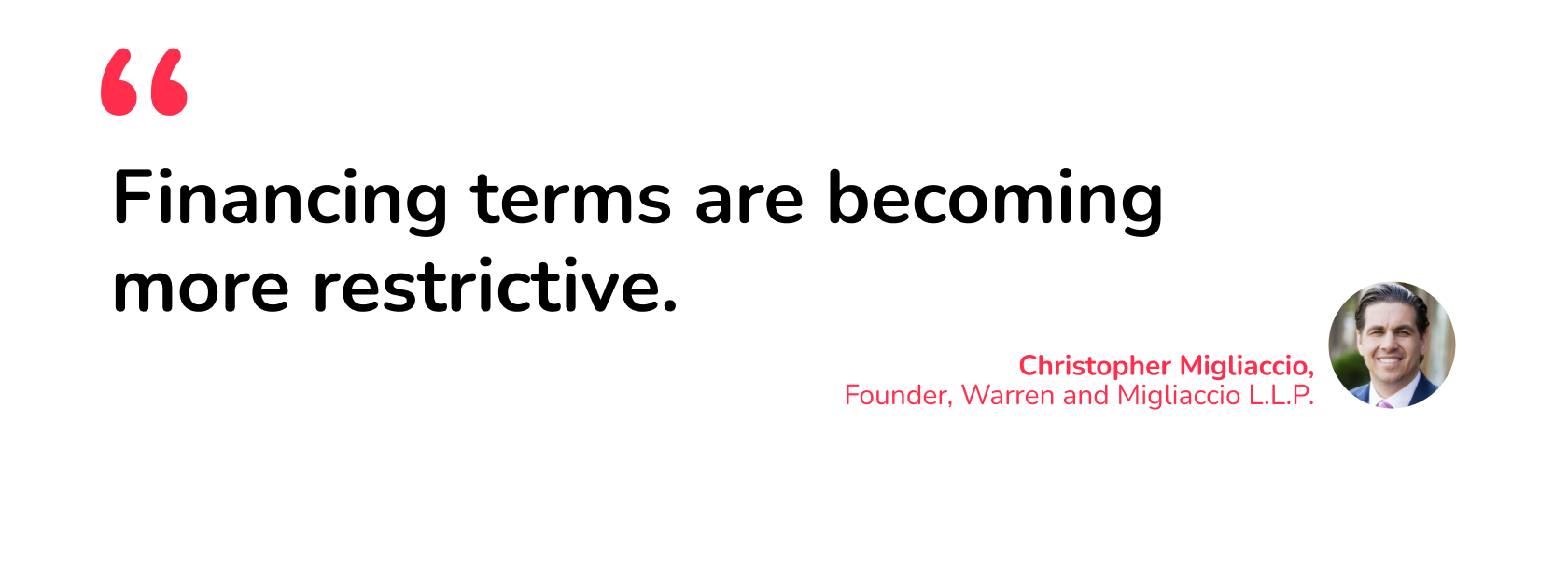
Lenders are scrutinizing deals more intensely. "Financing terms are becoming more restrictive as lenders are more closely evaluating the quality of the tenant, the length of the lease and compliance with ESG," says Christopher Migliaccio, founder of law firm Warren and Migliaccio L.L.P. "Clients should expect large reserves and strict covenant enforcement."
- ESG compliance costs are mounting. Properties failing ESG standards now face a "brown discount" exceeding 15% in competitive markets, according to Century 21. Energy performance requirements, stormwater regulations, and environmental compliance are becoming material underwriting factors that many investors still underestimate.
- Select market oversupply persists. While national fundamentals improve, some markets face localized oversupply – making market selection important. Vacancy edged up to 12.9% in Q4 of 2025 due to new deliveries, according to a Charleston industrial market report by real estate firm CBRE.
3 Industrial real estate market reports (top markets to watch)
While oversupply exists in some regions, these three markets and their local dynamics create strong opportunities:
Nashville industrial market report
Nashville continues showing resilience with vacancy at just 4.5% in Q4 of 2025, according to CRE firm Cushman & Wakefield — well below the national average. The market absorbed 5.4 million square feet in 2025.
Despite strong demand, the industrial sector in Nashville has limited available space, particularly for tenants requiring less than 50,000 sf. This means landlords of existing small-bay product will keep pricing leverage, as forthcoming supply – only a modest increase for 2026 – is unlikely to address all demand within this size segment. It also means that restructuring medium-to-large warehouses could bring strong returns.
Asking rent is on an upward trend in Nashville

Source: Cushman & Wakefield
Atlanta industrial market report
Atlanta's industrial sector is recalibrating after explosive growth. Vacancy climbed to 8.4% in mid-2025, Bull Realty reports, with rent growth decelerating to 1.1% year-over-year — down from 16% peaks in 2023.
Yet the region's Southeast location, airport infrastructure, and ongoing data center investments maintain long-term appeal. Prime infill locations near I-75 still command $9-15 per square foot, offering selective opportunities for disciplined investors.
Dallas-Fort Worth industrial market report
Dallas presents a contrarian opportunity for patient capital. While vacancy sits at 8.9% following years of speculative construction, Matthews reports, Q4 2025 showed renewed momentum with 8.1 million square feet absorbed.
The key opportunity here is large-format properties over 500,000 square feet, which now represent 30% of vacant inventory – creating below-market acquisition opportunities.
Average cap rates of 6.4% and rental rates rising 4.8% year-over-year signal the market is finding equilibrium. For investors comfortable with 2-3 year absorption timelines, DFW offers attractive entry pricing on institutional-quality assets.
Navigating the industrial property market in 2026
The industrial real estate market in 2026 rewards investors who understand that strong national fundamentals don't guarantee individual deal success.
Opportunity exists but is concentrated in modern facilities, strategic locations, and markets with balanced supply-demand dynamics. With the era of explosive growth seemingly over, what remains is a more selective environment where tenant requirements, financing terms, and local market conditions matter more than ever.
Speed and capital flexibility separate winners from those who watch deals slip away. When you spot the right industrial property in Nashville's tight market or Dallas's value-priced inventory, hesitation costs returns.
That's where Duckfund's soft deposit financing changes the equation. Lock in multiple properties with just 10% down while preserving capital for your next opportunity. Your competition is still trying to secure traditional financing.
Your next deal won't wait. Neither should you. Join 4,000+ CRE investors who've secured over $1.5 billion in deals with Duckfund's Sign Now, Pay Later model. Get 48-hour approval, zero upfront capital, and discounted rates starting month four.
Real Estate
Financing

- Approval within 24 hours
- Fund multiple properties at once
- No full deposit upfront — soft deposit only
- Apply in under 2 minutes
Secure your next commercial property acquisition — zero upfront capital required.
Start with Duckfund’s EMD financing program.- No capital commitment
- Close faster
- Scale with confidence