The Value-Add Commercial Real Estate Playbook: How To Find and Fund Better Deals

It’s tempting to think that the best value-add commercial real estate deals simply go to the highest bidder, but the seller often goes with the buyer they believe will actually close the deal.
This might be an uncomfortable truth to learn on a deal you’ve underwritten. It's also rarely the only thing that catches value-add investors out. If you’re one of them, you might also find:
- Month-to-month tenancies that pose a greater vacancy risk than you thought
- Deferred maintenance is priced as cosmetic, when the real cost lies in the mechanical systems
- The seller removes the property from the market for a buyer who committed earnest money faster than you could.
In a tight CRE market, these are mistakes that may end up costing you the deal, rather than a few basis points.
This guide covers seven ways to strengthen your value-add commercial real estate strategy, from spotting real upside to funding the deposit that locks the deal in, so that you don’t miss out on the next hot opportunity.
Contents
- What does "value-add" mean in real estate?
- 7 value-add commercial real estate tips for finding the best deal
- Lock down your next value-add property with Duckfund
Value-add deals go to whoever can move first. Contact Duckfund to find out how we fund your earnest money deposit within 48 hours of sign-up.
Fund your next real estate deal
- Access fast financing
- Grow your real estate portfolio

What does "value-add" mean in real estate?
Value-add is a commercial real estate investment strategy where you buy an underperforming property, improve it, then sell or refinance at a higher value.
Investors typically seek to raise the property’s net operating income through renovations and then by raising the rent. Managing the property more efficiently also helps to maximize returns.
That approach suits the current market. CBRE expects cap rates to fall by just 5 to 15 basis points in 2026, with total returns largely driven by income.
Asset selection and management are the key drivers of returns here, so investors are seeking to create the gain themselves, rather than wait for the market to raise values.
Core, core-plus, value-add, and opportunistic
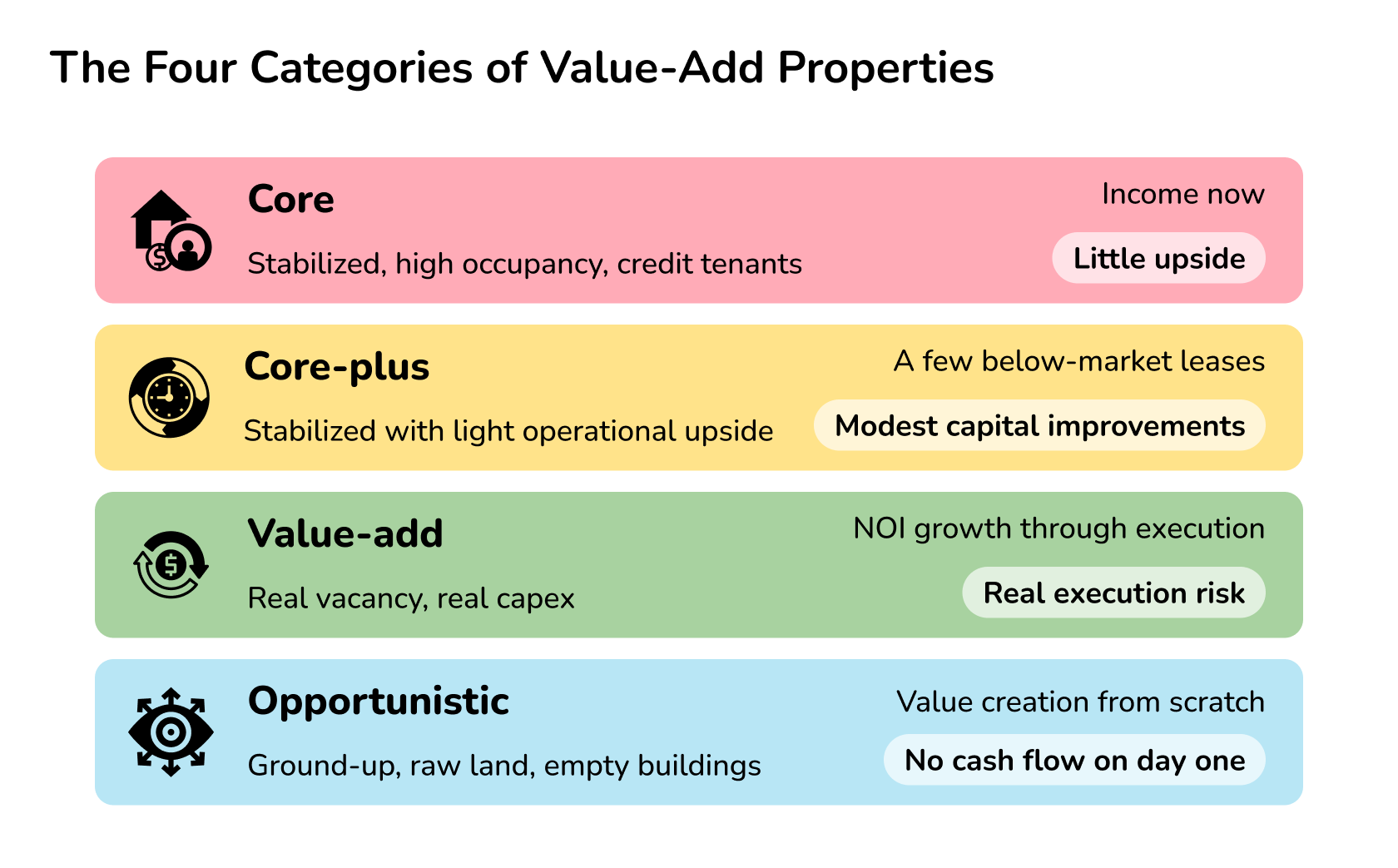
To help pinpoint value-adds, many investors divide commercial properties into sub-categories according to their risk and return profile.
- Core. These already have tenants in place and offer a stable income now, yet come with little upside.
- Core-plus. Also offer stable income, but a few below-market leases and modest capital improvements mean there’s a light upside.
- Value-add. The sweet spot for many investors. There are significant vacancies and capex, but also a real execution risk.
- Opportunistic. Involves developing raw land from the ground up or empty buildings. There’s likely to be zero cash flow for the first few months, or even years.
Yet recognizing which category a deal falls into is just the first step. The investors making strides right now are those who know how to spot a genuine value-add before the rest of the market does.
The seven signals below will help you become one of them.
7 value-add commercial real estate tips for finding the best deal
Each of the seven tips low tells you something different about a deal, and we can separate them into two areas. The first three are what to look for; the last four are what it takes to close.
1. Spot under-market rent before the broker prices it in
Below-market rents are common, but underwriting costs swallow the margin a lot of the time, and many investors don’t price this in.
Experienced investors have a strategy for this, which usually involves four simple steps.
- Compare the rent roll against submarket comps by unit type and vintage instead of building averages. This will show you whether the gap is real,
- Check the lease expiry schedule. If a lease rolls in 36 months instead of 12, then NOI growth will happen more slowly.
- Use loss-to-lease as a percentage of gross potential rent and check whether renewals are trending toward market. If they are, then the previous owner has already priced the gap into the asking price.
- Beware of concessions. Two months free on a 12-month lease may look like a minor incentive, but it cuts effective rent by around 17%, and this especially impacts value-add multifamily properties where the whole thesis rests on the rent gap.
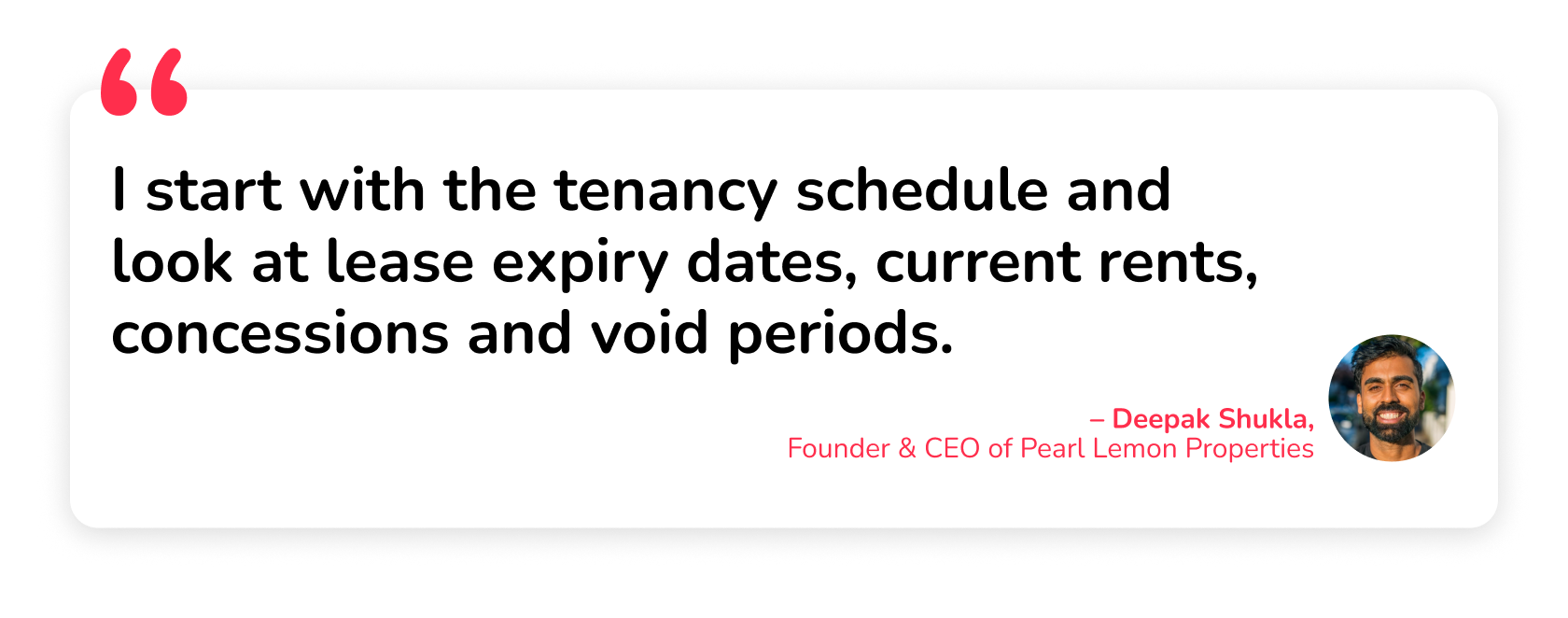
UK investor Deepak Shukla, Founder & CEO of Pearl Lemon Properties, follows the same order. "I start with the tenancy schedule and look at lease expiry dates, current rents, concessions and void periods,” he says.
Finding the time to carry out this work can save you a lot of money and hassle down the line. It might even tell you to walk away before you’ve committed a deposit.
2. Read deferred maintenance as upside, not a discount to argue over
There’s one question that every value-add investor should ask themselves regarding deferred maintenance: “Does fixing this raise the rent, or does it just stop a loss?"
Cosmetic work, including unit interiors and landscaping, usually passes the test. Tenants see it and are more likely to pay more because of it. It also moves NOI within a leasing cycle.
Structural and mechanical work is more difficult to justify on the same terms. Roofs, HVAC systems, electrical, and building envelope all protect the asset rather than growing it, so it’s smarter to put this in your capital budget than in your rent model.
Sellers tend to under-reserve for capex or let warranties expire before closing, both of which should show up in your due diligence if done properly.
This contrast is particularly important in value-add industrial properties where tenants will pay for clear height, power capacity, and dock doors over cosmetic finishes.
Still, whichever asset class you’re dealing with, it’s important to not treat defensive spending as upside. If you do, you’ll find that the renovation budget is spent before you improve a single unit.
3. Spot repositioning opportunities the seller never underwrote
Sellers can often miss repositioning possibilities in their underwriting, but these are often the largest sources of value creation.
The best places to look tend to be those that require a change of use rather than reconditioning.
Type conversion, such as when you turn obsolete office buildings into residential properties, is an excellent example. These have been shown to work best where the property’s characteristics (i.e., floor plan and location) suit the new use, and the seller has priced the asset on its falling income instead of its potential.
Tenant mix is another factor: one anchor lease can reset an entire center's rental rates.
Bringing operating expenses down is another potential win, and it’s one of the most reliable methods. This can include bringing property management in-house or moving utilities to RUBS – you can do both of these without speaking to a single tenant.
Zoning headroom is another opportunity here. Many sellers don’t price in unused density, which can support an extra building or expanded parking.
Repositioning the property comes with the heaviest due diligence of any value-add strategy, and this matters when you’ve committed capital and the clock is ticking.
4. Understand why value-add deals cost more upfront
Many investors underestimate how much value-add properties cost to get them into saleable condition.
Value-add deals tend to come with CRE bridge loans at higher rates and on shorter terms because they often don’t qualify for agency debt. Vacant buildings don’t have the stable income that credit providers lend against, and they’ll often want to see the business plan funded before they commit the money.
Investors need to show lenders they’re ready in three ways:
- Having capex reserves in place at closing
- Having the means to cover repayments while renovations are underway
- Showing they’re prepared for a longer due diligence window, with more complicated zoning, title, and condition reports.
Failure to have these in place often means investors end up gap funding the difference at the wrong moment, and potentially using the deal to a rival who had planned for it.
Every one of those costs lands before the first improved unit leases. Investors who run short here end up gap funding the difference at exactly the wrong moment — or losing the deal to someone who planned for it.
5. Know how much deposit a value-add deal actually needs
So, how much deposit for a value-add property should you plan for?
Earnest money deposits in commercial real estate typically run 1–5% of the purchase price and can run up to 10% in a competitive market. If an asset costs $10 million, then you’re probably looking at a six-figure amount before you’ve even completed diligence.
Value-adds often push this number higher because they come with longer due diligence, as mentioned, and sellers tend to price that delay into the deal.
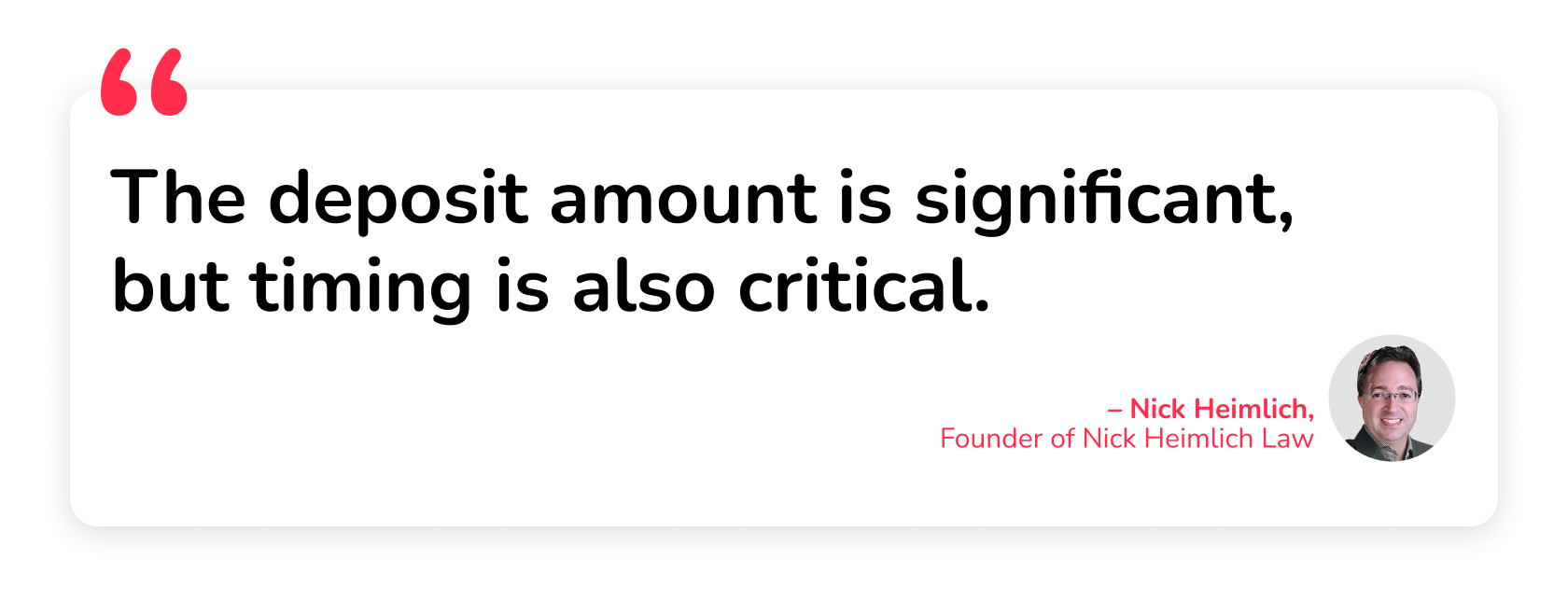
"Sellers are potentially more stringent in value-add deals in terms of the evidence of commitment before they are willing to remove the asset from the market,” says legal expert Nick Heimlich, founder of Nick Heimlich Law. “The deposit amount is significant, but timing is also critical.”
Value-add buyers often don’t realize just how important timing is here. Two deposits of the same size carry completely different risk depending on when they go hard.
On a value-add asset, where diligence runs long, speed is especially important.
6. Move fast enough to lock the deal
The best value-add deals attract many LOIs, but the seller often doesn’t go with the highest: they’ll typically look for the one least likely to fall apart.
Certainty is the key word here. A larger deposit and shorter contingency period are the clearest signal that you’re a committed buyer, and they can be factors that win the deal over a higher bid.
This does, however, pose a problem. You need the capital from that larger deposit for renovations and reserves – it’s no good over-committing cash if it ruins your business plan.
"Buyers should be careful in negotiating the point at which earnest money becomes non-refundable and the interplay with due diligence rights,” says Nick Heimlich. “A large deposit does not compensate for the loss of the right to walk away before completing satisfactory due diligence."
This leaves one question worth answering before your next LOI: does that deposit have to come out of your own capital at all?
7. Finance the deposit without eating into your renovation budget
There is an answer to the previous dilemma of putting down a large enough deposit without gutting your budget: don’t fund the deposit from your own balance sheet.
Bringing in a deposit from elsewhere means you don’t touch capital you’ve earmarked for renovations or reserves. It means you can also make funds work for you on other deals. Your business plan stays fully funded and your offer stays at full strength.
Many value-add investors turn to specialized EMD lending to make this happen. They can often offer a larger deposit amount than if from their own reserves, and the provider’s swift funding process means the cash moves quicker.
Lock down your next value-add property with Duckfund
Value-add acquisitions are capital-hungry and slow to underwrite, so they need a well-defined structure when it comes to funding a deposit for them.
Duckfund funds earnest money deposits from $25,000 to $3 million for value-adds within 48 hours. It takes a few minutes to apply, with approval normally arriving the next business day, and there’s no collateral required.
The deposit is fully refundable throughout due diligence: you keep the right to walk if the condition reports turn. Your own capital stays available for property renovations and reserves. And because there's no cap on concurrent deals, you can hold several real estate investment opportunities under PSA at once, which changes how you purchase real estate at scale.
Our fees are structured as LP soft costs, passed through at closing, with competitive rates that decrease for larger deposits.
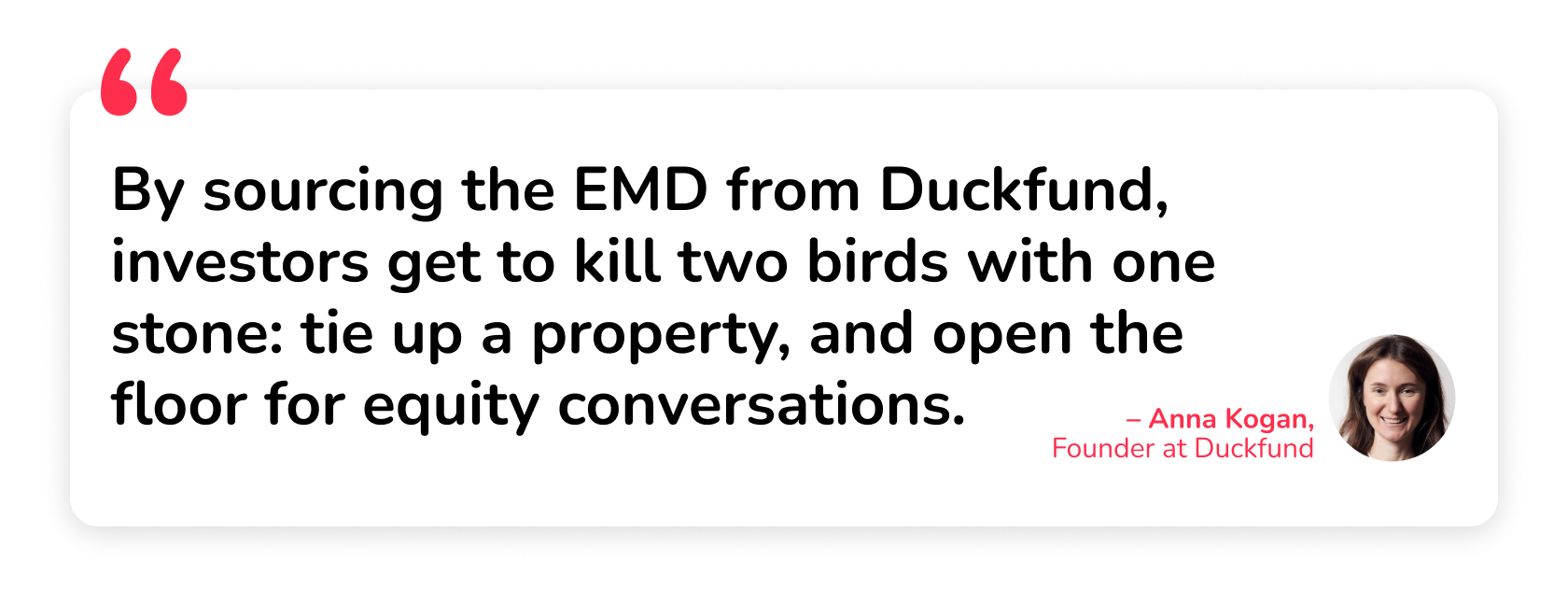
“By sourcing the EMD from Duckfund, investors get to kill two birds with one stone: tie up a property and open the floor for equity conversations,” says Anna Kogan, Duckfund’s founder.
The upside in value-add commercial real estate goes to whoever can move on it. Fund the deposit right, and your capital goes into the work that creates the value.
Contact us to fund your next deposit in 48 hours and keep your capital in your account.
FAQs
1. What is the difference between core and core-plus in real estate?
Core properties are fully stabilized with credit tenants and produce steady cash flow, but offer almost no upside. Core-plus investments are also stabilized, yet carry light operational improvements that can lift returns without the execution risk of a full repositioning.
2. What is a typical value-add deal size in commercial real estate?
Most private sponsors work between $5 million and $30 million, where an apartment complex or small industrial park is large enough to justify professional property management but still below institutional competition.
Below $5 million, operating expenses rarely support a dedicated management team. Above $30 million, you're bidding against REITs and funds.
3. How long does a value-add business plan take to reach stabilization?
Two to four years is standard, depending on lease rollover and the scale of redevelopment. Renovations usually run 12 to 24 months, then you need several quarters of stabilized occupancy at the new rental rates before a lender or buyer will underwrite the improved NOI.
4. Can you finance an earnest money deposit on a value-add acquisition?
Yes. Specialist EMD lenders fund the deposit directly into escrow, typically within 48 hours, provided it stays fully refundable and is held for the buyer's benefit. This keeps your own capital available for capital improvements during the acquisition.
5. What is core-plus real estate?
Core-plus real estate is a category below value-add property in terms of risk and earning potential. It already has a stable income, but offers a light upside that the investor can reach via rental increases and capital improvements.
6. How much earnest money is required on a large commercial deal?
As a rule of thumb, large commercial deals typically require between 1 and 5% of the purchase price, so a $10 million asset means $100,000 to $500,000 in earnest money. This can rise toward 10% in competitive markets like New York.
Real Estate
Financing

- Approval within 24 hours
- Fund multiple properties at once
- No full deposit upfront — soft deposit only
- Apply in under 2 minutes
Secure your next commercial property acquisition — zero upfront capital required.
Start with Duckfund’s EMD financing program.- No capital commitment
- Close faster
- Scale with confidence