Earnest Money Deposit Financing: The Complete CRE Investor's Guide

In commercial real estate, winning a deal often comes down to more than finding the right property or negotiating favorable terms.
Sellers want proof that you have both the financial capacity and the commitment to close, which is why earnest money deposits (EMDs) have become a standard part of purchase agreements.
For sponsors pursuing larger acquisitions, however, tying up hundreds of thousands (or even millions) of dollars in refundable deposits can create liquidity constraints long before the transaction reaches closing.
That's where earnest money deposit financing comes in.
Rather than using cash that could be deployed elsewhere, qualified investors can finance all or part of the required deposit, preserving capital for due diligence, operating reserves, tenant improvements, or additional acquisitions.
As competition for high-quality commercial properties intensifies in 2026, EMD financing has evolved from a niche funding solution into a strategic tool used by experienced sponsors to manage cash flow and scale their deal pipeline.
In this EMD financing guide, we will explore everything you need to know about earnest money and how you can fund it without tying up your cash. We’ll cover:
- What are earnest money deposits?
- How do earnest money deposits work in commercial real estate?
- What is EMD financing?
- What are the different EMD financing options in the US?
- Who are the top specialized EMD financing providers in the US?
- How does EMD with specialized EMD financing providers work?
- How can you access EMD funding for CRE in the US?
Do you want to gain an edge in competitive CRE markets? Contact us today to learn more about how our earnest money financing product can provide you with a competitive advantage.
Fund your next real estate deal
- Access fast financing
- Grow your real estate portfolio

1. What are earnest money deposits?
Earnest money deposits are the portion of a property’s purchase price that sellers expect you, as a real estate buyer, to pay as a show of commitment to go through with the deal.
Though not legally mandated, the use of earnest money deposits in real estate has become the norm because it protects sellers from wasting time on buyers who are only conducting market surveys.
As EMDs have become popular, buyers have also adopted them as a way to gain an advantage in competitive markets. For example, when the seller requests a 5% EMD, some buyers can offer up to 10% to gain the front seat.
In most CRE markets, once you pay the earnest money (also known as the good faith deposit or the soft deposit), the seller takes the property off the market, while you conduct due diligence. In other words, it gives you exclusivity as you work towards finalizing the deal.
2. How do earnest money deposits work in commercial real estate?
Before considering EMD financing, let’s take some time to understand how EMDs work in the US CRE.
Who makes the EMD?
The buyer makes the earnest money deposit as a signal of commitment and financial readiness to finalize the deal.
Who receives EMD?
Though it is sellers that demand EMDs, third-party agents (escrows) are the ones who hold the money paid.
An escrow agent can be a title company, a real estate agent, a real estate brokerage firm, a real estate attorney, or an escrow company (dedicated to acting as escrows).
Since the escrow is a neutral third party, it can only act based on the agreements between you and the seller. These agreements are usually contained in the Purchase and Sale Agreement (also known as the purchase contract).
How much can you expect to pay?
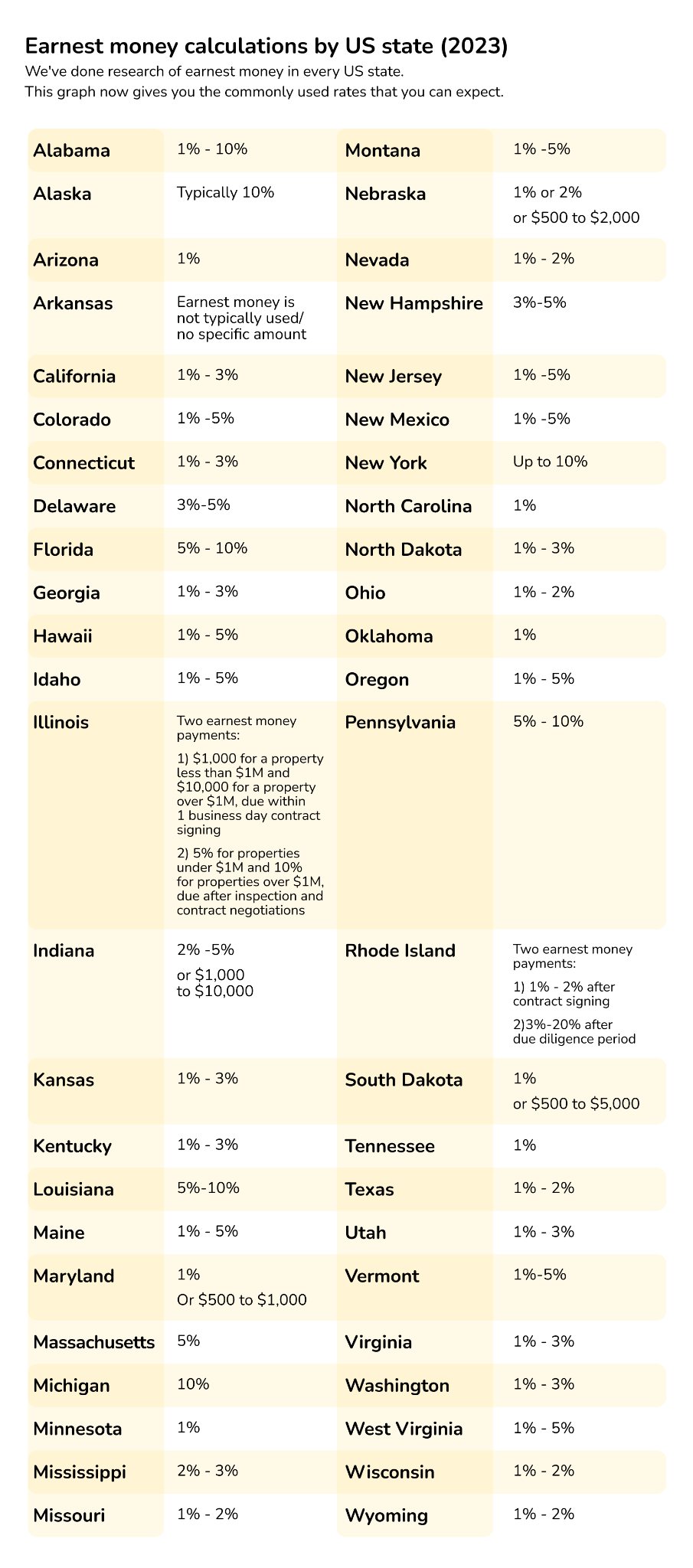
You can expect to pay anywhere between 1% and 10% of the purchase or sale price, depending on the state where you are doing the business.
Below is an overview of the average rates in various US states:
Are EMDs refundable?
EMDs are refundable, depending on the details contained in the Purchase and Sale Agreement (PSA).
In CRE, once you have deposited the earnest money, you get the right to a due diligence period, during which you can conduct inspections, verify the property’s title, and confirm other legal and environmental matters. During this period, the seller will usually take the property off the market.
However, it is necessary to include the duration of the due diligence period and the right to exclusivity in the PSA to avoid any legal issues down the line.
As said above, in most CRE markets, the right to exclusivity does not require any extra payment, as long as it has been carefully included in the PSA.
Now to the question: Are earnest money deposits refundable?
For CRE transactions, you can opt out of the deal for any reason during the due diligence period. However, once the due diligence period ends, the EMDs become non-refundable irrespective of the reason you want to back out of the deal.
This is in contrast to residential deals where you can opt out of the deal only for contingencies specifically listed in the PSA (financing contingency, home sale contingency, appraisal contingency, and home inspection contingency, etc.).
How is the EMD deployed?
If you decide to finalize the deal, the escrow will handle the EMD based on the terms in the PSA.
There are usually two options: use it to finance a part of the closing costs or as a part of the down payment for a mortgage loan.
What happens if a buyer doesn’t deposit earnest money?
If a buyer doesn’t deposit earnest money, a breach of contract can be said to have occurred. This can lead to legal actions, relisting of the property, and reputation damage.
The first thing to clarify is that a breach of contract can be said to occur if a buyer doesn’t deposit earnest money only if payment of EMD has been listed as a requirement in the PSA and a time limit was specified.
If this is so, then the seller can sue for damages for missing out on better offers. Also, they can cancel the contract and relist the property for new buyers. And this can lead to reputation damage for the buyer among other sellers.
Interestingly, there are certain situations where the seller opts to first issue a notice to pay to the buyer before taking action. This is like a period of grace within which the buyer can pay and get the deal back on track. However, notices to pay are less common in CRE.
Even if such notices to pay end up working, the buyer has suffered some reputation damage that makes it harder for them to negotiate better terms down the line.
3. What is EMD financing?
EMD financing (also called soft deposit financing) is a short-term funding solution that helps real estate investors, wholesalers, and sponsors cover the earnest money deposit requirement for different types of real estate deals.
Since EMD financing is a short-term solution that buyers embrace while they wait to secure permanent funding for the property, it is often seen as a form of gap funding or bridge capital for earnest money.
There are often three reasons why investors and sponsors use EMD financing:
- Temporary illiquidity: CRE investors and sponsors are sometimes short of cash, which necessitates exploring EMD financing while they work on securing permanent financing for the property in view.
“I’ve worked on deals where liquidity constraints around deposits limited how many opportunities we could pursue at once, which is a real bottleneck,” according to Deepak Shukla, CEO of Pearl Lemon Capital, a business and property financing company. “It is in these circumstances that EMD funding becomes interesting because they allow investors to fund deposits quickly, sometimes within 24–48 hours, without locking up capital, which can help scale deal flow significantly.”
- Working capital management considerations: Even when they are not illiquid, many investors are wary of locking valuable cash with escrows for weeks or months, especially if doing so will threaten working capital stability (by limiting operational reserves, for example). In that case, using other people’s money sounds like a good deal.
“Maintaining liquidity provides the investor with flexibility when it comes to conducting due diligence, addressing operational issues, and covering any unforeseen transaction-related expenses without having tied-up working capital for temporary deposits,” according to Nick Heimlich, the owner of Nick Heimlich Law, a business law firm.
- Exploring multiple investment options: Also, some sponsors and investors prefer to use available cash to pursue other investment options instead of locking it up in escrow accounts, especially when the EMD requirement is very high.
4. What are the different EMD financing options in the US?
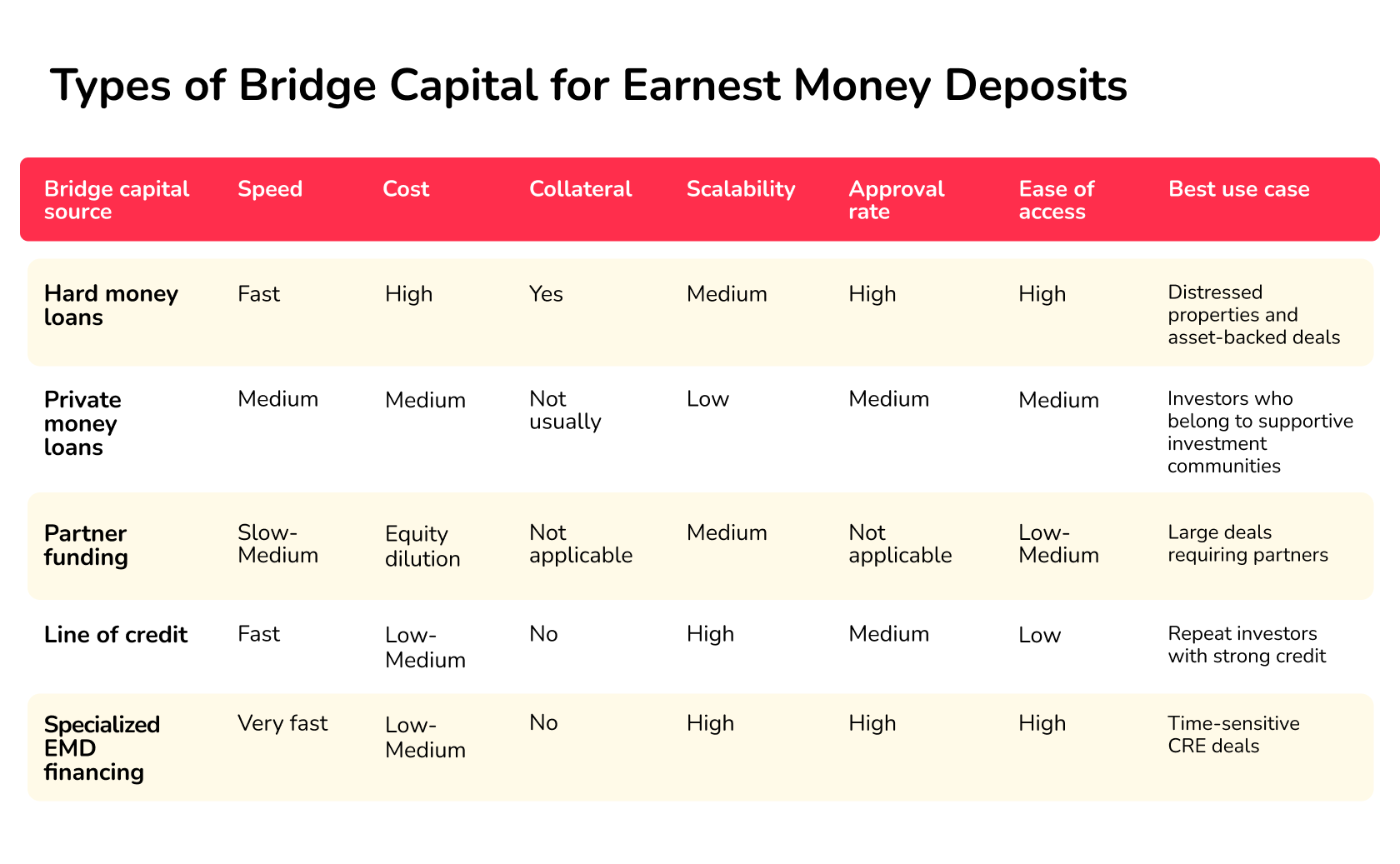
For investors and sponsors who don’t want to use their cash, hard money loans, private money loans, partner funding, line of credit, and specialized EMD financing are the different EMD financing options in the US.
In what follows, we review the pros and cons of each method and their applicability to the nature of EMDs in today’s CRE markets.
1. Hard money loans
Hard money loans are short-term, asset-backed loans that real estate investors use when they need quick access to capital. These loans are secured by a ‘hard’ asset, such as the property being purchased, rather than by the borrower’s creditworthiness.
Many investors use them for quick acquisitions or bridge financing. Since they can be quickly accessed, some also deploy them for bridge financing.
Pros of hard money loans
- Fast funding
- High approval rate
- Can be used for distressed assets
Cons of hard money loans
- High interest rates
- Requires collateral
- Borrower’s income or credit score is not that relevant
2. Private money loans
These are loans provided by private lenders as an alternative to traditional lenders (like banks and credit unions). In contrast to traditional loans, they are often more accessible, with flexible terms.
Private money loans often depend on the relationship between the lender and the borrower and/or the experience and creditworthiness of the latter. In other words, there is less emphasis on collateral.
Pros of private money loans
- Flexible terms
- Usually does not require collateral
Cons of private money loans
- Hard to scale for multiple real estate transactions
- May require personal guarantees
3. Partner funding
The sponsor of a real estate joint venture or syndication can borrow funds from one of the limited partners. In exchange, the limited partner can ask for a co-GP position, priority when distributing returns, a higher share of profit, or just repayment with interest.
Partner funding also applies when a solo CRE investor reaches out to an investor who supplies funds for the EMD in exchange for a share of profit.
Pros of partner funding
- No repayment is needed in most cases
- Well suited for large deposits
Cons of partner funding
- Often results in ownership dilution
- Slower to negotiate
- Complex negotiations
4. Line of credit
A business line of credit allows a CRE investor to borrow funds as needed up to a given limit.
Since it is mainly offered by traditional lenders, it often relies on the experience and creditworthiness (think credit report) of the investor.
Pros of a line of credit
- Reusable capital
- Quick access to funds
Cons of a line of credit
- Limited accessibility
- Often comes with restrictions and covenants
5. Specialized EMD financing
Specialized EMD financing is a dedicated financing solution that focuses solely on helping investors and sponsors meet EMD requirements.
They are often differentiated from other CRE EMD financing options by their speed, flexibility, and accessibility. Most EMD financing providers will supply funds within 72 hours, finance EMD for multiple deals, and ignore credit scores or credit reports.
Pros of specialized EMD financing
- Fast approval
- No collateral
- No credit score requirement
- Quick funding
Cons of specialized EMD financing
- Limited to verified deals
- Will require a PSA
Specialized EMD providers often provide the best EMD financing for CRE because they combine the advantages of other methods while avoiding their cons.
Like hard money loans, you can access funds quickly. Unlike them, however, you don’t need to provide collateral or pay high interest rates.
Also, they provide the same flexibility as private money loans without the focus on credit reports and personal guarantees. Moreover, they can be easily scaled to multiple deals.
Like partner funding, specialized EMD financing is ideal for large deposits. However, they are also easy to negotiate and do not dilute ownership.
Finally, while they can also be reused, like a line of credit, they do not require credit scores.
5. Who are the top specialized EMD financing providers in the US?
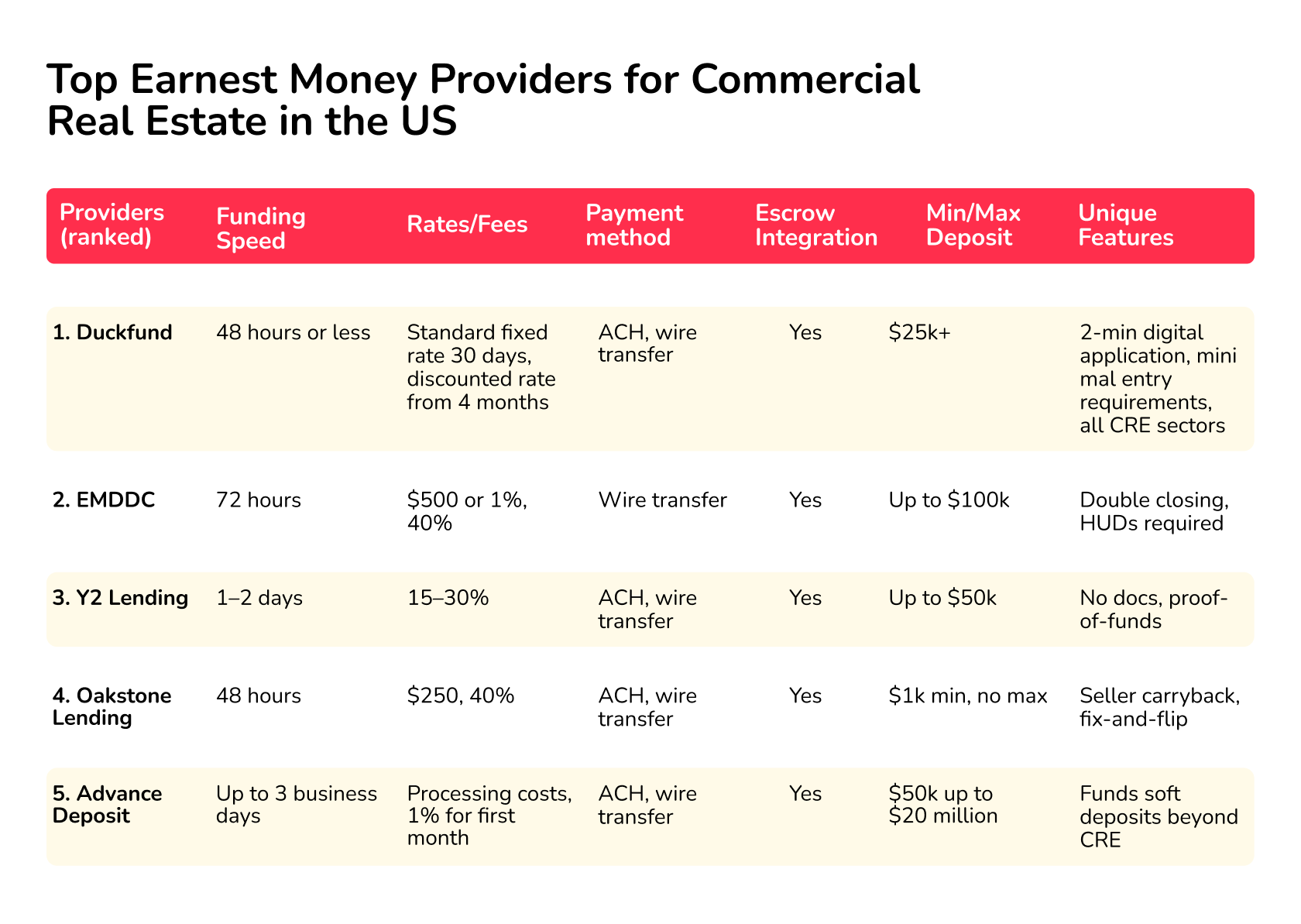
Duckfund, EMDCC, Y2 Lending, Oakstone Lending, and Advance Deposit are some of the top specialized EMD providers for CRE in the US.
Below is a summary of how they differ:
1. Duckfund
Duckfund has become the preferred EMD financing platform for serial CRE sponsors, having supported over $1.5 billion in CRE acquisitions while maintaining a 65% client retention rate and funding deposits from $25,000 to $20 million across multifamily, industrial, and mixed-use deals.
It thrives on providing quick access to funds, funding multiple simultaneous CRE acquisitions, and supporting investors who need to offer higher EMD amounts in competitive markets.
Also, you can complete an application within five minutes, without submitting any credit report.
2. EMDDC
EMDDC is a real estate financing company that also offers EMD financing services.
They also prioritize quick funding, providing access to funds within 72 hours. Instead of credit reports, they emphasize the investor’s experience.
However, EMDDC is often useful for small- to medium-sized CRE investors since EMD financing is capped at $100,000.
2. Y2 Lending
Y2 Lending is a private money lender that also offers earnest money funding solutions.
They support sponsors across different CRE sectors and focus on creating long-term relationships with clients. Users can access funds within 48 hours, and there are no collateral or credit checks.
Y2 Lending supports EMD funding up to $50,000.
4. Oakstone Lending
Oakstone Lending is a transactional lender that also offers an earnest money funding service.
They are known for supporting a variety of deals, including seller carryback and fix-and-flip transactions.
Oakstone Lending thrives on fast funding (within 48 hours) and a streamlined application process.
They also support small-scale investors, with a minimum EMD funding amount of $1,000.
5. AdvanceDeposit
AdvanceDeposit is a specialized EMD financing company available to investors and developers.
They finance deals up to $20 million, supporting large-scale CRE investors. Quick funding is another advantage, as they make funds available to escrows within 72 hours.
What should you look for when choosing a specialized EMD financing company? For Heimlich, experience, fee transparency, timing, and financing terms are the most important.
“When selecting an EMD financing firm, investors should consider the amount of experience that the firm has had with commercial real estate transactions,” he advised.
“Additionally, investors should carefully evaluate how transparent the firm's fee schedule is; how quickly the firm can fund an investment opportunity; and what terms the firm uses in its contracts.”
6. How does EMD financing work with specialized EMD financing providers?
EMD financing with specialized EMD financing providers often relies on the use of LLCs, which help to minimize the risk of the transaction, thereby increasing accessibility.
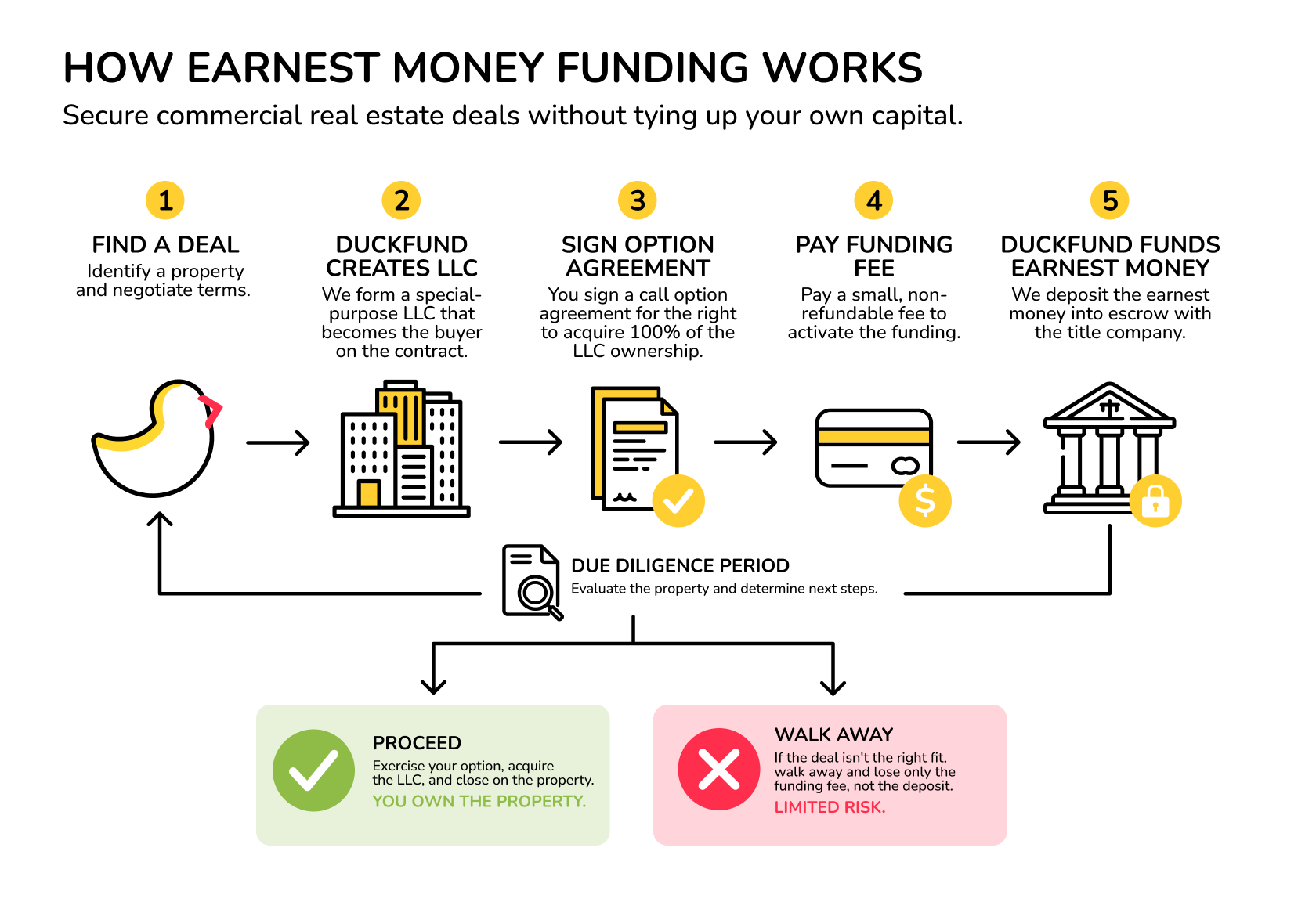
We can illustrate what this process looks like by considering how it works with Duckfund, one of the specialized EMD financing providers in the US.
Below are the steps to securing EMD financing with Duckfund:
- Find a deal: Identify a property you like and negotiate the terms for it.
- Duckfund creates an LLC: Once your funding request has been approved, Duckfund creates an LLC on your behalf. It is this LLC that signs the PSA.
- Sign option agreement: You will sign a call option agreement, which gives you the right to acquire 100% ownership in the LLC after you repay the EMD loan.
- Pay funding fee: You will be required to pay a small, non-refundable fee, which is a percentage of the earnest money loan amount.
- Duckfund funds earnest money: Duckfund will transfer the earnest money to the escrow on behalf of the LLC.
- Proceed or walk away: If you decide to finalize the deal, you will repay the EMD loan and exercise the call option agreement for a 100% stake in the LLC. On the other hand, if you walk away from the deal, you will not need to repay the earnest money; you will only lose the financing fee.
Below is a visual representation of this process:
7. How can you access EMD funding for CRE in the US?
You can access EMD funding in the US through a specialized EMD funding platform like Duckfund.
With us, you can complete an application within 5 minutes and get funds transferred to the escrow account within 48 hours or less.
Also, we finance multiple deals at the same time, and we allow you to propose and pay higher EMD amounts to gain an advantage in competitive markets.
We support CRE deals from all CRE categories, including multifamily, industrial, retail, and land, across the U.S (except California, Hawaii, Utah, Vermont, and Kansas).
Furthermore, our aim at Duckfund is to be your EMD financing partner, working with you as you build your CRE portfolio.
Are you ready to keep building your CRE portfolio without having to worry about earnest money deposits? Sign up or contact Duckfund to start working with a reliable EMD financing partner.
Takeaways
- Earnest money deposits have become normative as a way to protect sellers and an opportunity for buyers to compete in competitive markets.
- Earnest money financing is about preserving liquidity, not just solving cash shortages. Many experienced CRE sponsors finance earnest money deposits even when they have the cash available.
- Compared with hard money loans, private lenders, partner funding, and business lines of credit, dedicated EMD financing providers offer faster approvals, more accessibility, and greater scalability.
- Working with the right EMD financing partner gives investors the flexibility to pursue multiple opportunities simultaneously and even offer larger deposits in competitive bidding situations without tying up their own capital.
Fund your next real estate deal
- Access fast financing
- Grow your real estate portfolio
Frequently Answered Questions
1. How to secure earnest money deposits for commercial real estate quickly?
You can secure earnest money deposits quickly by applying through a specialized EMD financing provider, which typically requires a signed Purchase and Sale Agreement (PSA) and can fund the escrow account within 48 to 72 hours after approval. Compared with traditional funding options, specialized providers are designed specifically for the speed and timing requirements of commercial real estate transactions
2. Do platforms exist that fund EMD without credit checks or collateral?
Yes. Specialized EMD financing platforms like Duckfund are designed to fund verified commercial real estate transactions without requiring traditional collateral or relying on the borrower's credit score.
Instead, they evaluate the transaction itself and typically require documentation such as a signed Purchase and Sale Agreement before approving funding.
3. Can I use earnest money deposit financing for off-market commercial real estate deals?
In many cases, yes. Specialized EMD financing providers generally support both marketed and off-market real estate transactions, provided there is a valid Purchase and Sale Agreement (PSA) and the deal meets their underwriting requirements. The property's marketing status is typically less important than the strength and legitimacy of the transaction.
4. Does using earnest money deposit financing affect my ability to obtain permanent financing?
Generally, no. Earnest money deposit financing is designed as a short-term bridge solution that helps satisfy the deposit requirement before closing. As long as the financing is disclosed when required and is repaid according to its terms, it typically does not interfere with obtaining permanent debt from a bank, agency lender, or private lender. However, investors should always confirm that the structure complies with the requirements of their permanent financing provider.
Real Estate
Financing

- Approval within 24 hours
- Fund multiple properties at once
- No full deposit upfront — soft deposit only
- Apply in under 2 minutes
Secure your next commercial property acquisition — zero upfront capital required.
Start with Duckfund’s EMD financing program.- No capital commitment
- Close faster
- Scale with confidence